


"I speak English. I don't need a headset for interpreting."
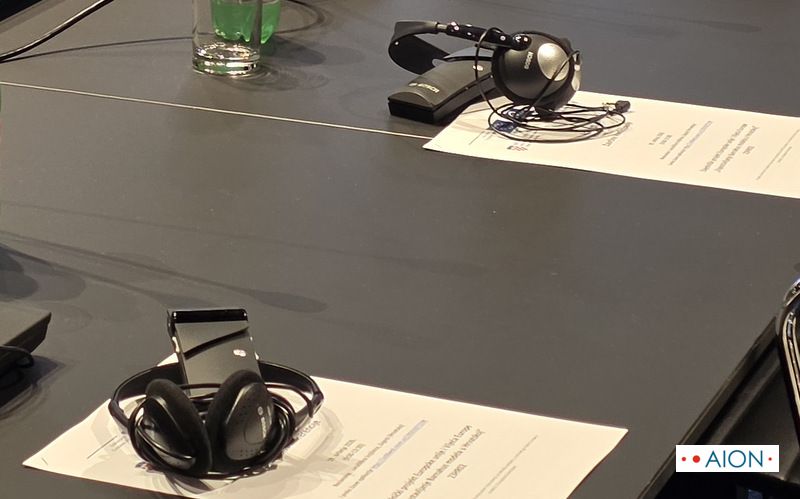
In most international conferences, the interpreter booths are set up, the headsets are distributed, and somewhere in the audience you bravely think: "I speak English, I don't need translation." Fair enough. But there are several reasons why even confident English speakers sometimes reach for the headset by the second session.
You may speak English well. But do you listen to it for hours?
Most professionals use English in controlled doses: emails, meetings, short exchanges. A conference is something else entirely. Four, six, eight hours of dense content, back-to-back speakers, shifting topics and registers. Listening fatigue in a second language is real — and it accumulates quietly, so you don't always notice how much you've missed until you're comparing notes with a colleague afterward.
One or more speakers may not be native English speakers either.
International conferences draw experts from across the world, and expertise does not come with a standardised accent or flawless grammar. A brilliant legal scholar from Warsaw, a leading researcher from Seoul, a policy expert from Paris — all presenting in English, all with their own relationship to the language, their own accent, their own rhythm. This is simply the reality of global professional exchange today. Which means that the English you hear in the room may test your comprehension in ways you didn't anticipate. An interpreter, working from the original — or from English into your language — smooths that out entirely.
Imagine your own field, in a language you don't own.
If you work in English every day, at the level of the conference topic, then by all means — no headset needed. But consider the seasoned lawyer, the specialist engineer, the senior policy advisor — perfectly competent in English for everyday purposes, now trying to follow intricate legal theory or technical specifications delivered at conference pace. The headset is not an admission of weakness. It is a professional tool — a crystal clean window to another world — and you use it because precision matters.
Not every speaker is a natural presenter.
Some experienced speakers are a pleasure to follow: measured pace, clear structure, key points underlined. But they are the exception. Most speakers are experts in their field, not in public delivery — they speak quickly, skip transitions, bury the headline. An interpreter's job is not just to translate words but to render meaning clearly, in real time. Sometimes the interpreted version is actually easier to follow than the original.
And next time, when a speaker sounds like they are speaking Klingon to you, you will be happily following their presentation with the headset on. And interpreters will try to decipher that Klingon for you!
The headset and interpreting offered at a conference are not trying to suggest you don't speak English. They are there because comprehension under pressure, across accents, across hours, across disciplines — is harder than it looks.
► Explore more conference know-how articles:
I need four languages for the conference, but how many interpreting booths?
How Many Interpreters Do I Need for a Conference?
How Conference Interpreters Prepare — and What Clients Can Do to Help
Cinema, School, or Round Table? How Your Seating Choice Shapes the Whole Conference