


Interpreter Brain Drain: Zen Gain
Neuroscience has some answers. Many things happen at once: listening, holding the thought in one language, finding the words in the other and speaking, with both languages awake the whole time. So many parts of the brain working together probably have something to do with that silence afterwards.
Other demanding jobs know this kind of exhaustion too, but few ask the brain to listen, understand, translate and speak at the same moment, at a pace someone else sets. This is also why interpreters work in pairs and swap every 20 to 30 minutes. Nobody does it alone for hours.
If you are planning a conference with interpreting, Aion will help you plan for the pairs, the breaks, and a booth where they can see, hear and breathe.
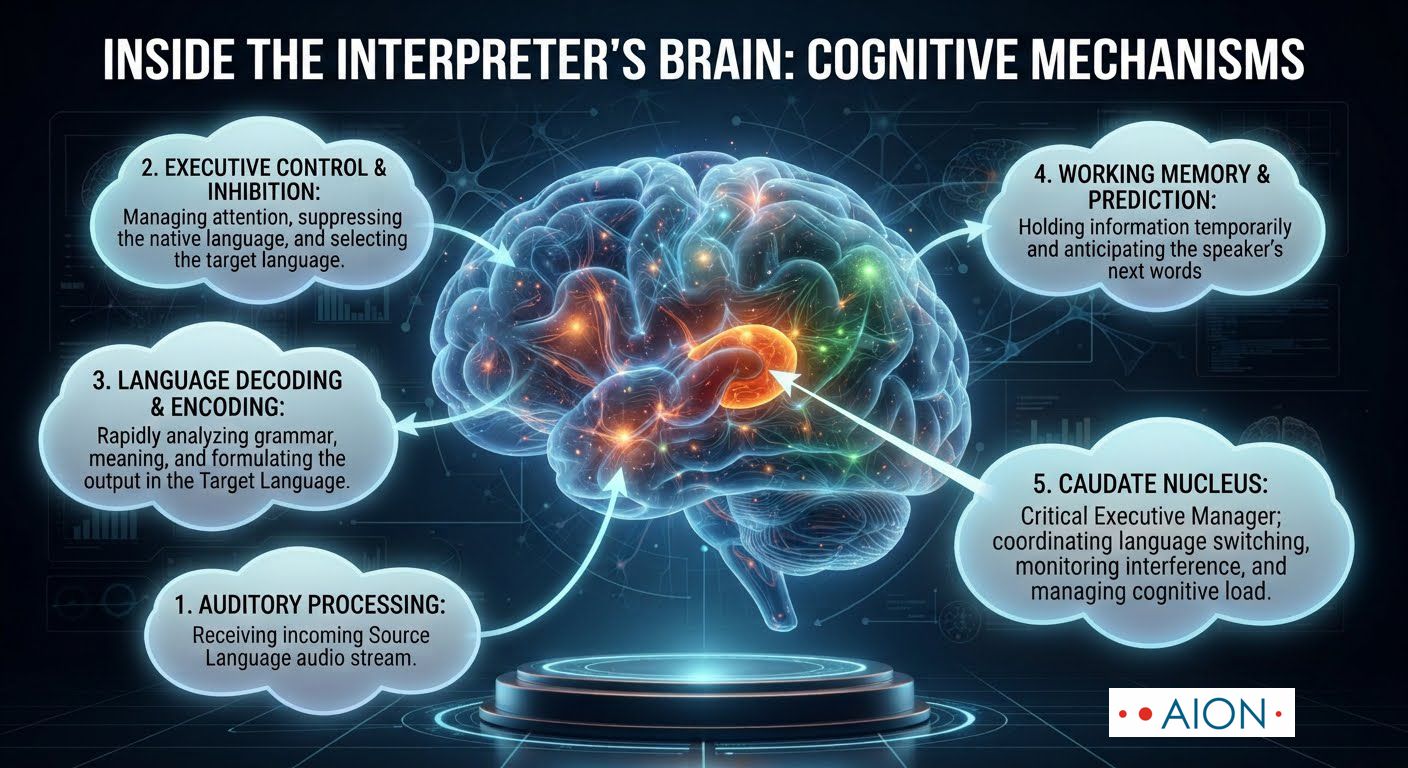
What do the numbers in the graphic mean?
The numbers are markers, not steps, because all the processes in the brain happen at the same time.
-
Auditory processing. The interpreter hears the speaker, but also their own voice, because they check what they say while still listening to what comes next. Two streams at once, one coming in, one going out. Keeping one ear half-uncovered by the headphone lets them hear their own voice better.
-
Executive control and inhibition. Both languages stay active. The brain steers between them, choosing the right one and keeping the other from slipping out mid-sentence. That steering takes effort even when nothing goes wrong.
-
Language decoding and encoding. The interpreter works with meaning, not word by word: they grasp what the speaker intends, then build it again in the other language, with its own grammar and register.
-
Working memory and prediction. The interpreter holds a few seconds of speech while the speaker carries on, and often anticipates where the sentence is going. That is especially useful when the verb comes last.
-
Caudate nucleus. A deep brain structure that seems to play a part in switching between languages. Neuroscience is still working out its exact role, in interpreting and in the brain generally.
Note: the graphic is an illustration only, not a figure from a neurology paper.
Learn more about simultaneous interpreting and conferences in our other stories:
What Simultaneous Interpreting Really Takes?
Lecterns, Earset Mics, and Goose-necks. A Practical Guide to Conference Microphones
I need four languages for the conference, but how many interpreting booths?
Cinema, School, or Round Table? How Your Seating Choice Shapes the Whole Conference