


What Simultaneous Interpreting Really Takes?
Picture the range: a conference on central banking one day, on international law the next, then veterinary inspection protocols, post-earthquake building codes. A good interpreter has done all of it. Colleagues joke that between them, they are carrying glossaries they do not even remember learning.
The foundation. Fluency in two languages is the minimum, not the standard — because languages carry history inside them, and translating one well means understanding how it got there. Take the French word ordonnance: in different legal contexts, it can mean either "ordinance" or "regulation" in English, while the two are not interchangeable in EU legislation. Choosing the wrong one does not just blur the sentence — it can quietly misstate the law.
The pressure. Beyond languages, interpreters need working knowledge of law, economics, and whatever sector the room happens to be discussing that day — because at some point, on any topic, someone will make a joke about a balance sheet, or ask a pointed question about criminal liability, and there's no pausing to look it up. Context arrives at the same speed as the sentence.
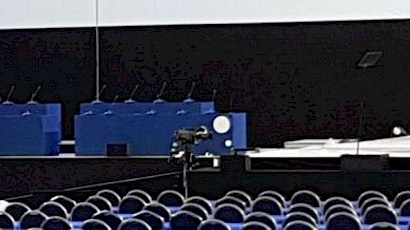
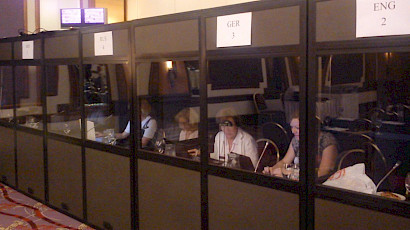
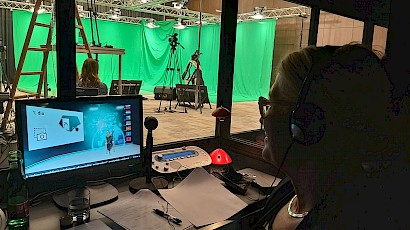
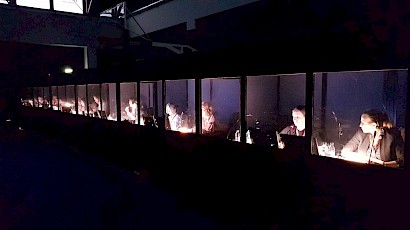
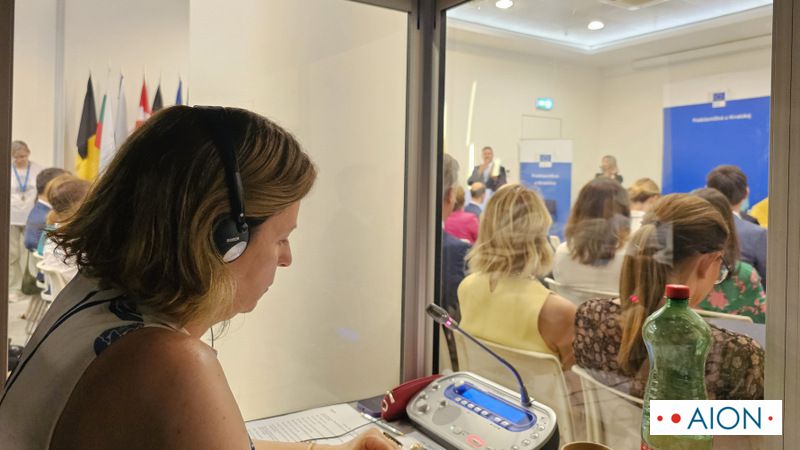
The nerve. Experience is not just years on the job — for younger interpreters especially, it is learning to withstand the room. An interpreting booth is a small, enclosed space, with a single pane of glass separating the interpreter from the audience and from everyone they can see: an audience of 300, a prime minister or two. In that moment, it is not the speaker the audience is really hearing — it is the interpreter, with only glass between them. Many who know both languages perfectly still cannot shut out the room beyond it, and the moment they start noticing it — the pulse suddenly loud in their own ears — concentration starts slipping. One missed second is enough to lose whether the answer was "yes" or "no" — and from there, the sentence that follows is a coin flip.
This is the work behind the thirty years — hundreds, maybe thousands of hours, of conference interpreters at Aion refining not just language but judgment: internal round tables, terminology debates, senior interpreters passing down what no textbook teaches. It's what high-level clients are actually paying for when they ask for "an interpreter" — not a voice, but all of this, standing calmly behind it.